Why Feeder Tails Are Becoming Hybrid Generation–Consumption Zones
Introduction: A Shift at the Edge of the Grid
Traditionally, the feeder tail—the most downstream point of the distribution network—was seen as a passive consumption zone. Power flowed one way from the substation through feeders to end-users, with little need for control or planning. However, this model is changing.
Due to new technologies and policies promoting electrification, the feeder tail is becoming an active part of the grid. It is no longer just a consumption point, but a zone where both generation and consumption occur. As we move toward a more distributed, digital, and decarbonized grid, understanding and optimizing this transformation is essential.
Feeder Tail Disruptions: From Solar Saturation to Electrification Load Spikes
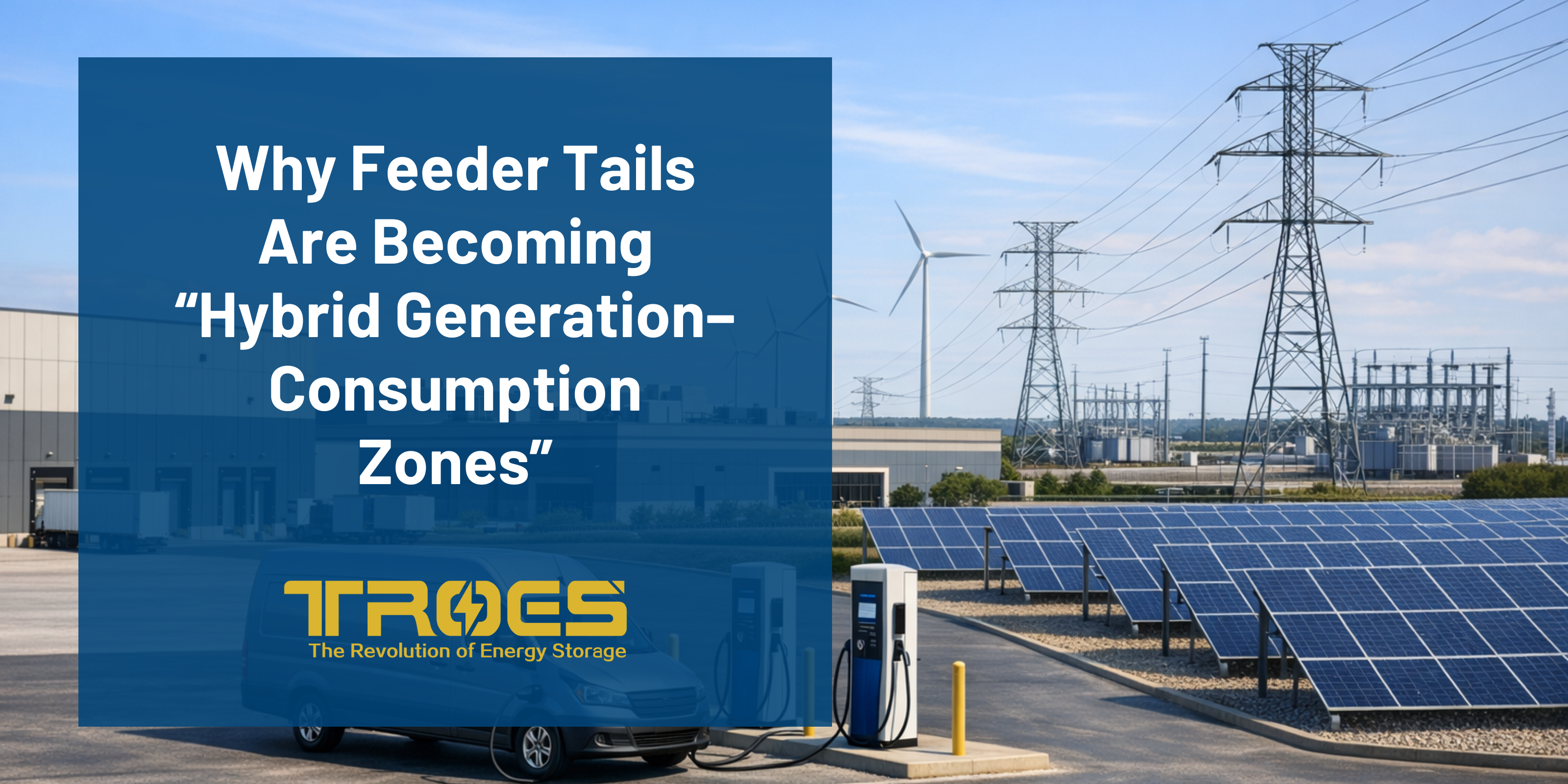
Over the past decade, distributed solar PV has grown quickly, especially in residential, agricultural, and small commercial areas. This is especially noticeable at the feeder tail, where rooftop systems are commonly installed on homes, barns, and local businesses. At midday, solar production often exceeds local demand, sending excess power back toward the feeder head and substation. If unmanaged, this can cause over-voltage, inverter shutdowns, and feeder-level instability. For example, in Vancouver, systems under net metering are limited to 100 kW, a sign of growing concerns over grid balance and power exports.
At the same time, the shift toward electrification is adding new types of demand at the grid edge. Electric vehicle (EV) chargers are becoming widespread. Quebec’s “Roulez Vert” program offers rebates of up to $600 per Level 2 home charger and $5,000 per multi-unit building. In BC, rebates reach up to $350 per home charger and $2,000 per charging port for multi-family buildings. In Ontario, areas like Peel and York are seeing commercial buildings install large-scale chargers that can increase feeder loads by several hundred kW with little notice. All these leading to a significant increase in EV charging stations at the distribution edge. Unlike traditional loads, EV charging is highly unpredictable, depending on user behavior. Fast DC chargers, in particular, can cause sharp demand spikes.
Additionally, incentive driven thermal loads such as heat pumps, electric boilers, and thermal energy storage systems are expanding rapidly under building electrification initiatives. For example, The Canada Greener Homes Grant and CMHC’s Deep Retrofit Accelerator are promoting the adoption of heat pumps, thermal storage, and smart thermostats, especially in rural and low-income areas. These devices often operate in synchrony—particularly during early mornings and evenings—creating coincident peak demand events. In rural areas, where infrastructure is often aging or capacity-constrained, this seasonal variability adds yet another layer of complexity to feeder-level planning and stability.
All of these trends are changing the role of feeder tails. They are no longer just endpoints, but active zones with both generation and fluctuating demand. Utilities now face:
These challenges highlight the need for new technologies in the grid tools and control assets to ensure system stability and planning certainty.
Why Energy Storage Systems Are Key “Buffer and Control” Assets
Battery Energy Storage Systems (BESS) are one of the best solutions to support utilities in this transition. BESS offers flexibility, fast response, and smart controls that help stabilize complex feeder tails. Their value is not just in storing and releasing energy, but in actively managing voltage, frequency, and two-way power flow in real time. BESS also reduces the need for expensive and slow upgrades to substations or feeders. Instead, capacity and stability can be added where needed, making the grid more flexible and cost-effective.
BESS offer the flexibility, speed, and intelligence required to stabilize feeder tails. Their value lies not just in energy capacity, but in their control capabilities:
| Grid Challenge | BESS Role |
| Midday over-generation from rooftop solar | Absorbs surplus PV, preventing over-voltage and curtailment |
| Evening EV charging spikes | Discharges to support peak demand, avoiding transformer stress |
| Thermal load fluctuations | Smooths seasonal and daily variability, enabling electrification |
| Two-way power flow uncertainty | Real-time dispatch based on net load conditions |
| Lack of reactive support at feeder tail | Provides voltage regulation, frequency response, and black start support |
Grid Architecture Implications: From Linear to Nodal
Under this transition, the traditional linear grid model (central plant → transmission → distribution → load) no longer reflects reality. BESS at the feeder tail marks a shift to a nodal grid where control assets are distributed:
Supporting LDCs Through Storage Partnerships
To keep up with this transformation, Local Distribution Companies (LDCs) should review their Distribution System Plans (DSPs), focusing more on edge-located storage. Regulators could also start valuing local flexibility and two-way power flows in future rate models. At the same time, technology providers can offer modular solutions designed for smaller substations and feeder tails.
LDCs are in a strong position to lead this change. By working with energy storage companies, they can tap into real-world experience in system integration, control strategies, and project execution. Unlike general consultants, storage providers bring hands-on deployment knowledge.
For instance, where transformer loads exceed 85% during peak hours, a 2 MW / 4 MWh battery at the feeder head can reduce demand and extend equipment life. In rural areas with voltage issues from solar exports, front-of-meter BESS can provide fast voltage support.
Some LDCs are also testing “dispatchable load zones” with storage aggregators. These programs coordinate behind-the-meter batteries to provide grid services. They treat distributed storage as flexible capacity, adding value without expanding the grid.
Beyond deployment, storage companies can assist LDCs with:
Through these partnerships, LDCs gain a more agile toolkit for grid reform, while leveraging the innovation and execution capabilities of the private sector.