Beyond Energy Savings: The Technical and Economic Foundations of Microgrid Deployment

As electricity demand grows, microgrids are emerging as a practical solution to grid capacity constraints, energy resilience, and evolving customer needs. Driven by EV charging, electrification, and data center expansion, their applications are extending beyond remote communities into urban and grid-connected environments.
However, turning microgrid opportunities into successful projects still requires overcoming challenges in technical integration, project financing, utility interconnection, and stakeholder coordination. Addressing these barriers calls for collaboration across the energy ecosystem.
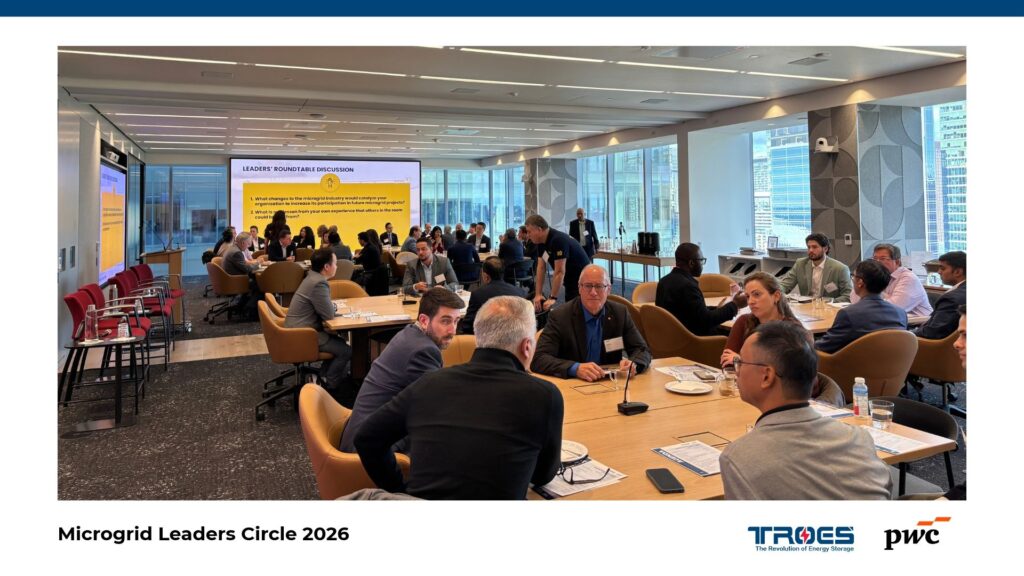
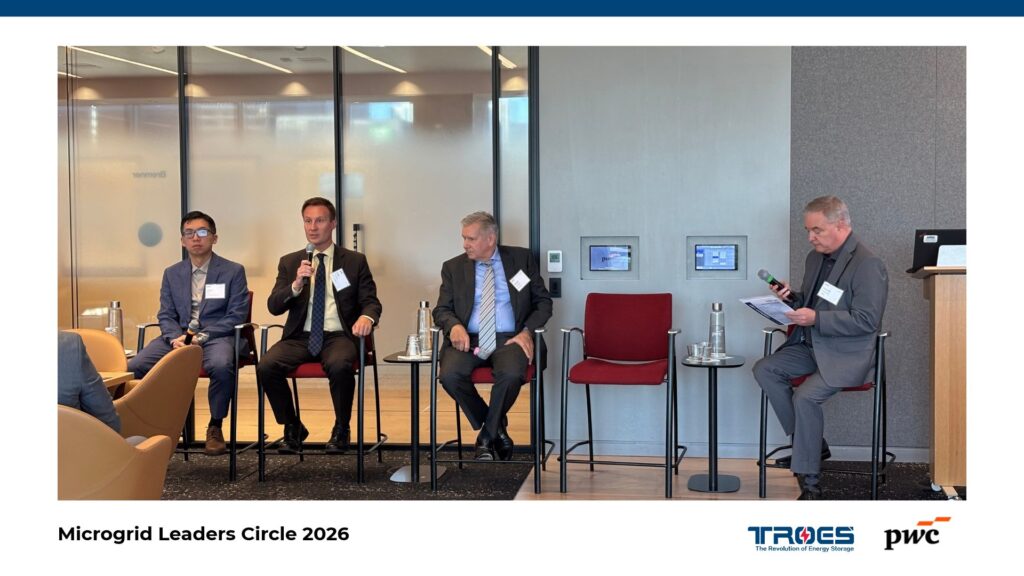
These opportunities and challenges were at the center of the TROES–PwC Microgrid Leaders Circle 2026, which brought together representatives from more than 40 companies and organizations, including pioneers, industry leaders, and key decisionmakers shaping the future of microgrids and distributed energy. Experts from TROES, PwC, Honeywell, Stantec, York University, GrandBridge Energy, Gorkon Industries, and Otter Energy shared their perspectives on the technical, commercial, and regulatory challenges facing microgrid deployment, while representatives from the Ontario Energy Board and other participating organizations contributed valuable insights during the audience Q&A. Bringing together utilities, technology providers, engineering consultants, project developers, regulators, and energy end users, the event fostered meaningful dialogue and cross-industry collaboration around a shared goal: turning microgrids from promising concepts into scalable, commercially viable energy infrastructure.
1. Beyond Energy Savings: Microgrids as Power Infrastructure
Electricity cost reduction remains an important driver of commercial and industrial battery storage projects. However, growing electrical demand is shifting attention toward infrastructure capacity and operational resilience.
Addressing Capacity Constraints
High-power EV charging illustrates this challenge. Commercial facilities and fleet operators may require chargers rated at 100–400 kW, while existing electrical infrastructure may lack sufficient capacity. Utility upgrades can be costly and time-consuming, prompting customers to explore battery storage, solar generation, and intelligent controls to accommodate new loads within available capacity.
Increasing demand from AI infrastructure and data centres further reinforces the importance of flexible, locally managed energy resources.
Quantifying the Value of Resilience
For critical operations, the economic consequences of power interruptions can extend well beyond lost electricity.
A Quebec food-processing facility discussed during the event, for example, reportedly required approximately five hours to return to full production following an outage. This illustrates how production downtime and recovery costs can outweigh conventional electricity savings.
TROES is exploring an integrated solution that combines uninterruptible power supply (UPS) functionality with peak shaving. By enabling rapid battery response during grid disturbances, such a system could help protect critical processes, reduce production interruptions, and improve asset utilization.
2. Strengthening Project Economics Through Multiple Value Streams
Financing and uncertain returns remain significant barriers to microgrid deployment. Improving project economics requires maximizing asset utilization while establishing credible long-term revenue and financing structures.
Value Stacking Across Applications
A single battery-enabled microgrid can support multiple applications at once — solar energy storage, peak demand management, and backup power — and earn further value through grid programs such as Ontario’s IESO Capacity Auction, BC Hydro’s Demand Response for Business, and Hydro-Québec’s demand response options. Capturing that stack is a dispatch problem: the applications must be coordinated so that serving one does not compromise another.
Recognizing Grid-Level Value
Microgrids also create value for the distribution network itself, through flexible capacity and local demand management — value that depends on when and where the resource is available, particularly on constrained feeders. GrandBridge Energy’s GridShare program illustrates how customer resources can be compensated for providing exactly these local grid services. Ontario’s regulatory framework increasingly recognizes this role for non-wires solutions: the Ontario Energy Board’s Benefit-Cost Analysis Framework, including its Distribution Service Test, requires utilities to weigh such alternatives against conventional infrastructure investment. Recognition is not entitlement, however — utilities must still demonstrate that a proposed solution delivers value to ratepayers, and regulatory support does not guarantee any project’s eligibility or approval.
Flexible Financing and Community Investment
Power purchase agreements (PPAs) and service-based financing can reduce upfront capital requirements by spreading payments over time.
Community bonds offer another potential financing pathway. Ontario renewable energy cooperatives such as WindShare and SolarShare demonstrate how local investment has supported renewable energy development.
Actually, a well-designed system also raises returns on three fronts. First, right-sizing: a modular system sized to the facility’s actual load profile, rather than an oversized standard package, puts every dollar of capital to work — no capacity is paid for and left unused. Second, software-enabled stacking revenue and third, integrated design combining battery, inverter, controls and operation management in a single unit — sharply reduces on-site integration and commissioning costs.
3. Utility Coordination and Grid Integration
Engaging the utility early is not courtesy — it is risk management, because interconnection requirements shape the design itself. A utility studies everything behind a Point of Common Coupling in aggregate: a site with 4 MW of combined capacity is assessed as a 4 MW resource, with limits on export, fault current, and protection that depend on the feeder, not on the customer’s plans. If those limits surface after equipment is selected, the project pays for them twice — in redesign, in re-studies, and in equipment that turns out to be wrong for the connection it was bought for.
Early engagement also supports project scheduling, as interconnection studies and approvals can require substantial lead time. Involving utilities during initial planning helps identify technical constraints, clarify connection requirements, and explore potential opportunities under applicable grid programs. While early coordination does not guarantee approval, it can reduce uncertainty and improve project readiness.
System Integration and Right-Sizing for Commercial Viability
Successful microgrid deployment depends on coordinating multiple energy resources within a system architecture aligned with operational requirements and project economics.
Multi-Resource Design and Interoperability
A microgrid is not equipment stacked together — it is resources matched to loads. Solar, battery storage and generators behave very differently, and so do the loads they serve: industrial machinery may need millisecond response, while refrigeration tolerates a slower transition. Sizing and coordinating each resource against those load characteristics is what determines whether the system performs.
Interoperability decides the rest. With multiple suppliers, consultants and integrators on one project, standardized communication and clearly defined control responsibilities are essential — without them, well-chosen equipment still fails as a system.
In practice, interoperability has to be designed in, not added later. For example TROES systems are built on open standards — IEEE 2030.5, Modbus TCP/IP and MQTT — and integrate with third-party EMS platforms, so every resource in the microgrid can exchange data and accept coordinated control within a multi-vendor architecture, subject to project-specific compatibility requirements.
Conclusion
Microgrids are evolving from energy-saving technologies into infrastructure — addressing capacity constraints, operational resilience, and distribution-system flexibility. Their commercial success rests on more than technology: credible economics, flexible financing, early utility coordination, and integrated system engineering must work together. Scaling them will take collaboration among utilities, technology providers, engineering partners, regulators, and energy users — the connection of perspectives the TROES–PwC Microgrid Leaders Circle was convened to create, turning microgrid opportunity into practical energy infrastructure.
References
Ontario Energy Board. Benefit-Cost Analysis Framework for Addressing Electricity System Needs. May 16, 2024.
Ontario Energy Board. Framework for Energy Innovation 2.0 — Non-Wires Solution Incentives and Distribution System Code Amendments. November 2025.
Ontario Energy Board. Non-Wires Solutions Guidelines for Electricity Distributors. Updated July 2026.
GrandBridge Energy. GridShare Program and OEB Approval. 2026.
TROES–PwC Microgrid Leaders Circle. Panel Discussions and Audience Q&A. October 5, 2026.
Editorial Note
This article draws on discussions at the TROES–PwC Microgrid Leaders Circle and publicly available industry and regulatory materials. It is intended for educational purposes and does not represent a verbatim transcript or the official positions or endorsements of participating organizations. Technical requirements, program eligibility, and financial outcomes are subject to project-specific conditions and applicable regulations.